 Government of Jamaica

October 10, 2025
Source: NFA, FAO
St. Thomas, Jamaica – For the first time in Jamaica, marine fish farming is being piloted through a cage mariculture project, under the Shrimp and Red Snapper Pilot Grow-Out within the CARICOM initiative – marking a groundbreaking step for the country’s blue economy. Implemented by the Food and Agriculture Organization of the United Nations (FAO) in close partnership with the Ministry of Agriculture Fisheries and Mining and the National Fisheries Authority (NFA), the initiative forms part of FAO’s wider Caribbean programme to pioneer marine finfish and crustacean farming across the sub-region.
With an investment of approximately J$ 63 million covering the red snapper grow-out pilot in Jamaica and shrimp grow-out pilots in Saint Lucia and Saint Kitts and Nevis, the project is designed to strengthen regional capacity in marine aquaculture while providing sustainable solutions to declining wild fish stocks.
At the centre of the project, a new marine centre has been constructed at the NFA Bowden Harbour facility in St. Thomas to serve as a hub for research, training and technical support. To date, red snapper fingerlings have been successfully imported, and two 12-meter cages have been built, launched, and moored in Bowden Harbour.
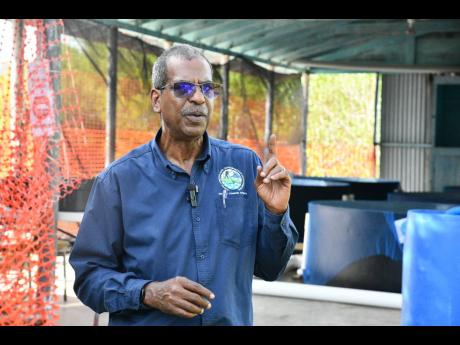
The Honourable Floyd Green, MP, Minister of Agriculture, Fisheries and Mining, speaking at the project site, underscored the strategic importance of this venture.
“This is a historic step for Jamaica. By piloting marine fish farming in our own waters, we are taking decisive control of our food security and pioneering a new frontier for our blue economy. This recirculating system allows us to sustainably cultivate red snapper from fingerling to harvest, and the expertise we gain here will be the foundation for scaling this success in partnership with the private sector.”
The Honourable Floyd Green, MP, Minister of Agriculture, Fisheries and Mining
This initiative directly supports the Ministry’s New Era of Agriculture and Fisheries; driving efforts to modernize and diversify the fisheries sector, reduce pressure on nearshore stocks, expand aquaculture production and unlock new economic opportunities for coastal communities.
Addressing the pressing challenges facing artisanal fishers, Minister Green explained how mariculture offers a viable solution.
“This pilot is a strategic solution to a pressing problem. It will help relieve the pressure on reef fish, reduce our dependency on imported fish, and most importantly, create a more reliable and profitable livelihood for our fishers.”
The Honourable Floyd Green, MP, Minister of Agriculture, Fisheries and Mining
Looking ahead, Minister Green positioned the pilot as a cornerstone of a broader vision for the sector.
“This snapper project is a key part of the wider vision of the Ministry of Agriculture, Fisheries and Mining to establish a leading mariculture facility in Jamaica. We are charging forward to diversify what we do, from marine snapper to sea moss, and oyster, ensuring we build a resilient and profitable future for our fishing industry.”
The Honourable Floyd Green, MP, Minister of Agriculture, Fisheries and Mining
During the installation phase, NFA technical officers received training from international mariculture experts in cage construction and marine finfish farming techniques. NFA divers were also trained in mooring and launching finfish cages, a critical step in preparing for the transfer of red snapper juveniles into the grow-out system.
The next phase will see these fingerlings transferred into the cages to continue the grow-out cycle, with close monitoring of growth, survival and environmental performance.
Dr. Gavin Bellamy, CEO at the NFA mentioned that the successful deployment of Jamaica’s first marine finfish cages marks the dawn of a new era for Jamaica’s fisheries sector.
“Our team at the NFA, in close collaboration with FAO, has worked diligently to establish this pilot, from the intricate recirculating system on land to the robust cage in the open water. The data we gather on red snapper growth, health, and sustainability will be the blueprint for a new, climate-resilient industry.”
Dr. Gavin Bellamy, CEO, National Fisheries Authority
FAO’s latest global assessment of marine fish stocks, released in June, shows that while 64.5 percent of fisheries remain within biologically sustainable limits, more than a third (35.5 percent) are now overfished. These findings underscore the urgency of expanding sustainable aquaculture as a complementary source of seafood production.
FAO Representative for Jamaica, The Bahamas and Belize, Dr. Ana Touza, emphasised the role of innovation in tackling future food challenges.
“This project represents a shift in how we think about food security. By integrating technology and science-based approaches into marine aquaculture, we are opening new pathways to produce healthy, high-quality seafood while reducing pressure on wild fish stocks. It’s about creating a resilient, sustainable sector that nourishes our people, protects marine ecosystems, and supports economic growth.”
Dr. Ana Touza, FAO Representative for Jamaica, The Bahamas and Belize
Highlighting the project’s capacity-building focus, Project Manager, Mohamed Diop noted that skills transfer is just as critical as fish production.
“This pilot is about more than producing fish, it’s about building lasting capacity. Through the construction of the marine laboratory and offshore cages, and by pairing NFA staff with international experts, we are ensuring that Jamaica gains the skills and infrastructure needed to lead its own mariculture industry into the future.”
Mohamed Diop, Project Manager
Beyond the technical trial, the initiative aims to create new livelihood opportunities for coastal communities and advance regional expansion of aquaculture as a sustainable source of income.
Greetings , happy new year to the Team at ( NFA )
Well, am a registered farmer @ RADA
But, I realized that I also has had a passion for fishery, for example, fish.farming at my farm.in Portland Cottage, Clarendon.
I already got the.fish.pond at my farm, I will send you a picture of it.
Question ?
Do i need a license.to farm Tilapia fish at my farm ?
The issues am having with the.fish.pond, it were sitting there for a long time, not being used, so it.( cracked all over the ( bottom n sides, etc.
I am asking for advise to see.if the ( membrane fish pond tick plastic can use to cover the entire fish pond ?
They sell them.on ( Amazon )
Question ?
Can I get the ( membrane fish pond plastic )
to buy at ( NFA ). ?
Question ?
Can I apply for ( job vacancy ) at NFA. on line ?
sincerely, D J
Happy New Year DJ,
For all your fish farming needs contact our Aquaculture Division at (876) 984-9343/9444 or view our Contact Us page and call one of the Aquaculture Extension Officers.
As in relates to vacancies, you would email your documents to the email provided in the advertisement.