 Government of Jamaica

Source: St Kitts Nevis Observer
Jamaica’s Ministry of Agriculture, Fisheries and Mining is working on increasing home grown food production and build a sustainable blue economy through a new Red Snapper Cage Culture Pilot Project.
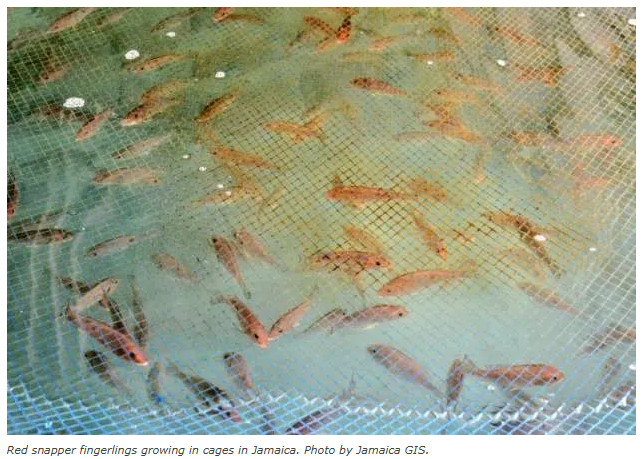
The experiment is led by the United Nations Food and Agriculture Organization (FAO) in partnership with the National Fisheries Authority (NFA) and is part of a $63 million regional Shrimp and Red Snapper Pilot Grow-Out Programme under CARICOM, being carried out in Jamaica, St. Lucia, as well as in St. Kitts and Nevis.
In Jamaica, the project takes place at the NFA’s Bowden Bay Mariculture Research Facility in St. Thomas. NFA Chief Executive Officer Dr. Gavin Bellamy said the effort fits within the Ministry’s “FACE of Food” programme, which focuses on food security, agribusiness, climate-smart technology, and export growth.
Dr. Bellamy said the goal is to help Jamaica achieve food independence by increasing marine fish stocks and making healthy protein more available at affordable prices.
The project also has environmental benefits, helping reef fisheries recover and creating space for other marine species to return.
According to the FAO’s 2025 report, 64.5 per cent of global fisheries are still within sustainable limits, while 35.5 per cent are overfished. The new red snapper project aims to ease pressure on reef fish and promote sustainable fishing.
Jamaica now imports about 80 per cent of its fish, despite being one of the world’s highest consumers. Dr. Bellamy said the pilot could lead to import substitution and future exports if done properly.
FAO Representative Roslyn Jackson-Richards said strong public-private partnerships are vital for long-term success. She added that the project will not only boost fish production but also improve coastal livelihoods and expand the aquaculture sector.
The pilot is more than 70 per cent complete. The next phase will move fingerlings into anchored sea cages for the grow-out stage, where their growth and environmental impact will be closely monitored.
Results, costs, and best practices will be shared with CARICOM partners when the project ends in 2026.